The rise of agentic AI for energy systems in the physical world: reality vs hype
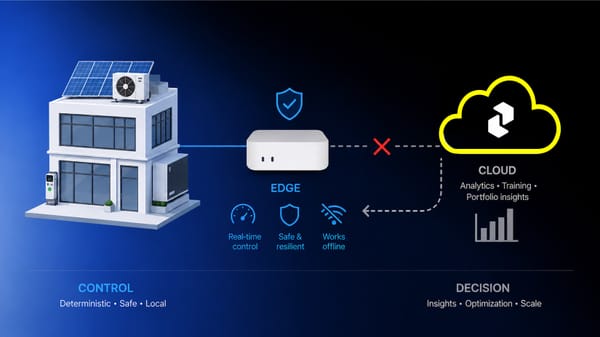
Agentic AI in energy is moving toward hybrid systems, not edge-only or cloud-only autonomy. In Europe, roles split across cloud optimization, edge control, and infrastructure layers. Preflet is an edge-first approach. The future is physical AI combining edge execution with cloud coordination.


For more than a decade, digital transformation in buildings and industrial environments has been dominated by dashboards, alerts, and analytics layers. These tools helped operators see more, but they did not act. They waited for a human to interpret the data and manually click buttons.
Agentic AI is now challenging this architecture entirely. Instead of presenting information, it evaluates the environment, determines the next action, executes it, and learns from the outcome. This shift mirrors what is happening across European industry, where 31% of enterprise AI investment in manufacturing now goes to Physical AI systems, including robotics and autonomous equipment, surpassing software‑only AI investment for the first time by Q2 2027 (Hyperion Consulting 2026). A similar trend is emerging in the energy and built‑environment sectors.
The energy industry is entering one of the largest technological transitions since electrification. Across Europe, utilities, industrial firms, grid operators, and building owners are racing to integrate artificial intelligence into energy infrastructure. The narrative is seductive, often marketed as self‑running buildings, autonomous energy systems, AI‑managed grids, and automated electricity markets. But the reality is more complex. Behind the marketing language lies a truth of energy systems. They are among the hardest environments in the world for autonomous AI because the electricity that runs them is not digital.
Historically, energy grids were centralized, predictable, fossil‑fuel dominated, and one‑directional. Today they are decentralized, bi‑directional, and saturated with distributed energy resources (DERs) such as heat pumps, batteries, EV chargers, and rooftop solar. Buildings are undergoing the same transformation, combining traditional HVAC with on‑site generation, storage, and flexible loads.
Why rule‑based automation is no longer enough
Anyone who has spent a career configuring BMS schedules, tuning PID loops, or maintaining rule‑based automation already knows the limits of static logic. Rules do not adapt to volatile spot price changes, grid flexibility signals, sudden occupancy shifts, rapid weather changes and multi‑system interactions. This is why traditional rule‑based automation is insufficient for modern energy systems. The sector is also facing a structural workforce challenge. Operators are retiring, engineering talent is scarce, and domain expertise is disappearing. Microsoft specifically highlights workforce shortages as a major reason utilities are deploying autonomous agents to act as “institutional memory layers.”
What agentic AI actually does in physical environments today
Buildings are becoming autonomous energy nodes and represent one of the most practical entry points for energy AI. They are semi‑contained environments, data‑rich, highly inefficient, economically measurable, and less safety‑critical than transmission grids, yet still constrained by physical and regulatory limits.
The largest real deployment category today is HVAC optimization, where AI systems adjust heating, cooling, ventilation, and thermal storage. These systems can enable demand response, but only in a subset of modern buildings with the right connectivity and equipment.
Another promising use case is Virtual Power Plants (VPPs), where AI coordinates home batteries, EV fleets, flexible loads, and distributed renewables. Europe has significant untapped flexibility potential, but orchestration across heterogeneous environments remains a challenge.
Despite the hype, AI deployment is far from widespread across the building stock. Operational constraints, network reliability issues, and equipment heterogeneity limit adoption. Claims such as “self‑running buildings” or “AI controlling infrastructure” are often exaggerated. In practice, building operators still define constraints, automation systems remain primary, and optimization layers operate within predefined boundaries. True reasoning is still limited.
It is true that 67% of enterprises using multi‑agent AI have adopted it in IT operations, HR, customer service, and invoice processing. But adoption in energy systems is progressing at a much slower pace due to physical, safety, and regulatory constraints.
Should agentic AI run locally?
Even if we assume a mature agentic AI, energy systems require far more than reasoning. They require physics awareness, stability guarantees, provable safety, physical modelling and deterministic control execution. LLM‑style agents are weak in many of these areas because they are probabilistic, non‑deterministic, and dependent on connectivity. Real buildings require constant monitoring, minute‑by‑minute optimization, fault tolerance, and deterministic behaviour. A system that is 92% confident is unacceptable in energy or industrial environments. If the internet fails, the building must continue operating safely.
Architecture of Agentic AI for Energy Systems
Most serious professionals do not believe that agentic AI alone will run energy systems in buildings. The emerging consensus is a hybrid architecture that combines cloud, edge and human supervision for PID loop to adjust for present error (Proportional), accumulating past errors (Integral), and predicting future changes (Derivative) to maintain a precise target. This will incorporate physical equations, constraint solvers, control theory (feedback loops, stability margins, voltage/frequency regulation, inverter response systems, dynamic controls) and formal verification to produce safe decisions. Modern energy systems are evolving into a layered intelligence stack where physical infrastructure, data, interoperability, AI agents, orchestration, and human oversight work together to enable adaptive, real-time energy optimization instead of fixed rule-based control.
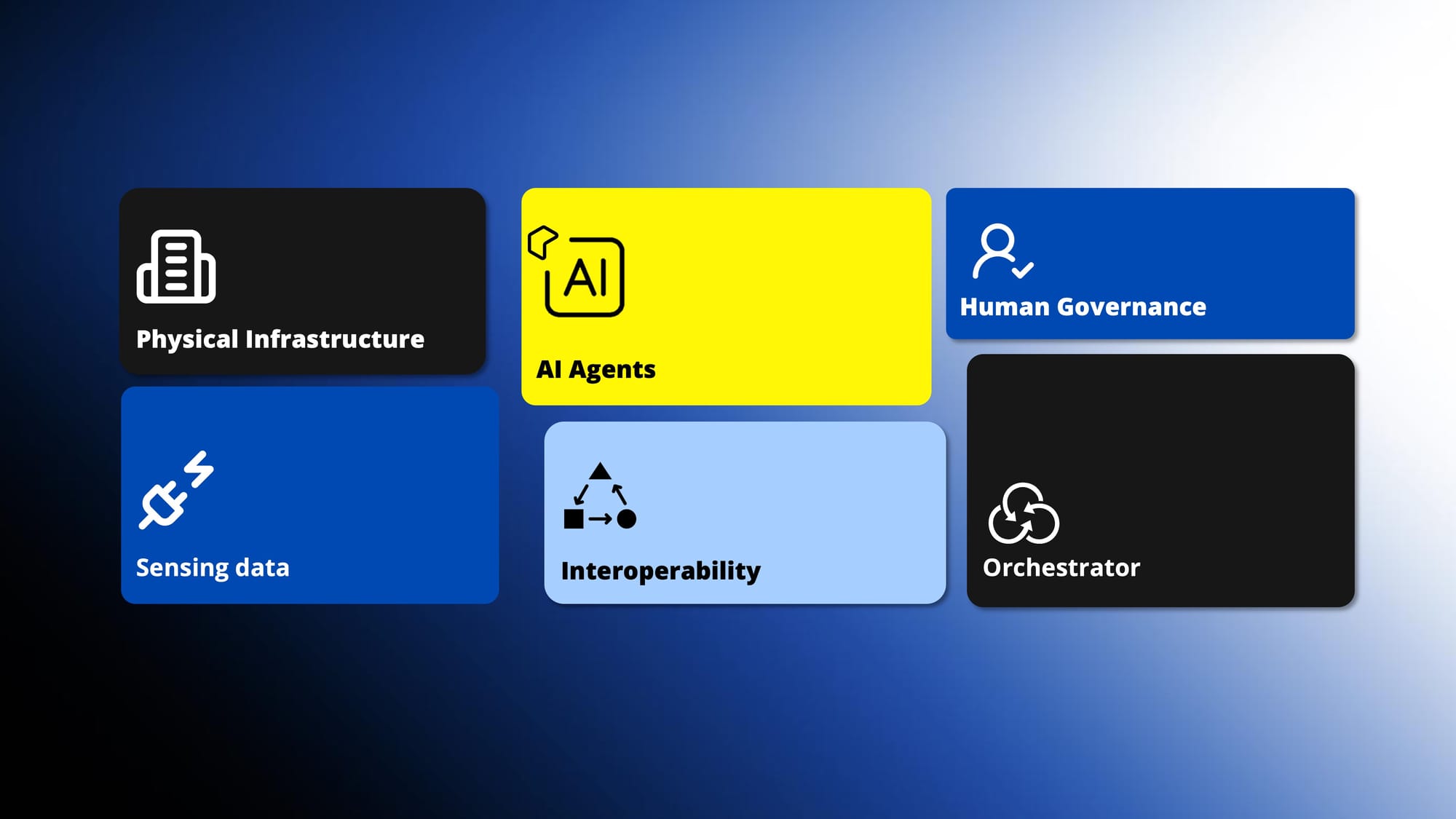
Physical infrastructure: The base layer consists of the real-world assets where energy is produced, stored, transformed, and consumed, as well as transformers, substations, solar systems, batteries, buildings, heat pumps, and EVs.
Sensing data: This layer converts physical activity into digital signals using IoT sensors (temperature, occupancy, CO₂), smart meters (kW/kWh), weather feeds, and industrial Supervisory Control and Data Acquisition (SCADA) systems
Interoperability: This layer connects heterogeneous systems across vendors and legacy infrastructure using protocols such as BACnet, Modbus, KNX, and BMS/EMS APIs.
AI Agents: Multiple domain-specific agents operate in parallel, each handling a specific function such as demand forecasting, outage prediction, energy trading, battery dispatch, grid congestion, cybersecurity, voltage optimization, and EV charging coordination. These agents form a multi-agent system where outputs are continuously coordinated, similar to distributed control systems like air traffic management.
Orchestration: A coordination layer manages interactions between agents, enforces constraints, and ensures system stability. It integrates zero-trust principles, local real-time controllers, and fallback mechanisms to keep operations safe and consistent across the system.
Human Governance: Humans remain responsible for oversight of high-risk decisions, regulatory compliance, and strategic control, with the ability to override automated systems when necessary.
| Dimension | Cloud-First | Edge-First | Hybrid |
|---|---|---|---|
| Connectivity | System breaks without internet | local physical control offline | local + external intelligence e.g. spot price |
| Latency | ~200–500 ms | <10 ms | Low locally, cloud for optimization |
| Control | Security exposure | Strong local control | Local safety + cloud oversight |
| Complexity | Low | Medium | High |
| Compute | Data process in cloud | Local processing | Process local + store cloud |
Market direction of agentic AI for energy systems in buildings
The market is moving toward hybrid AI-driven energy systems that combine edge intelligence with cloud coordination, but the reality in Europe is still that there are no truly edge-only autonomous energy AI systems at scale. Instead, the ecosystem is structured into distinct layers across startups, industrial firms, and infrastructure enablers.
Building intelligence and energy efficiency platforms
Building intelligence startups such as NODA and Aedifion sit in a more hybrid building analytics and optimization layer, combining cloud-based AI, real-time building data integration, and performance monitoring to improve energy efficiency across building portfolios. While BrainBox AI or R8tech focus on AI-driven optimization of building energy systems, primarily using cloud-trained models that interact with existing building management systems to optimize HVAC and energy consumption.
Distributed energy flexibility and grid orchestration startups
Distributed energy startups such as Kraken Technologies, GridBeyond, and Capalo AI focus on flexibility and real-time coordination of distributed assets like EVs, batteries, and industrial loads. These systems execute decisions at the device or asset level but rely heavily on cloud platforms for optimization, forecasting, and system-wide coordination across large networks.
Industrial systems, infrastructure enablers, and edge connectivity layers
Industrial firms such as Siemens, Schneider Electric, and ABB focus on edge control combined with cloud coordination, where real-time operations like grid stability, building automation, and substation control happen locally at the edge, while cloud systems handle analytics, optimization, and fleet-level intelligence. Enablers like Axelera AI and the Fraunhofer Society develop the underlying hardware, edge AI chips, and hybrid AI-physics frameworks that make both edge and cloud intelligence possible. Wattsense sits in this infrastructure layer as an edge gateway provider for connectivity and protocol translation in fragmented building systems, without performing edge AI or autonomous optimization.
Edge-first evolution in building control
A step further in a more edge-first architecture, running energy controls locally already been taken by Preflet GmbH, which cloud mainly for model training, and historical analysis, coordination, and redundancy for safety. It represents one of the more advanced attempts in Europe to move beyond cloud-centric building optimization toward localized decision-making, and it has also submitted a patent application to the European Patent Office (EPO) for its edge–cloud coordination approach.
The rise of agentic AI in the physical world is the name baseline, shifting from analytics and traditional rule‑based automation towards autonomous decision‑making. Overall, Europe’s energy AI landscape remains a hybrid AI, not cloud-only, edge-only autonomy. The direction is clear. Agentic AI is moving into Physical AI at production level across industries
Discover how energy systems in buildings are becoming smarter with an edge-first approach. Reach out to the Preflet team here →